Building Bridges: Meet Moyosore Somide, Director of Community Legal Services
February 03, 2026
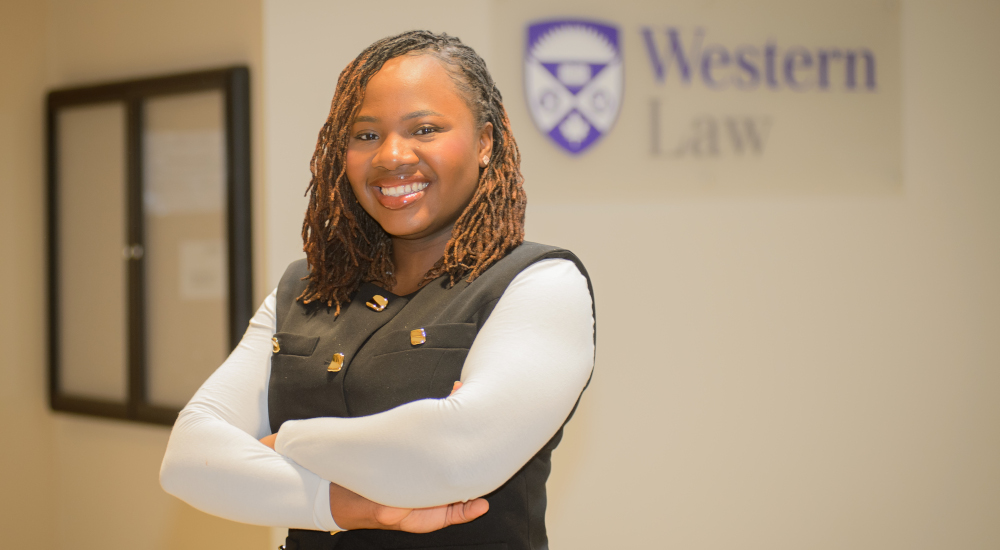
Moyosore Somide brings entrepreneurial vision and a deep commitment to access to justice to her role leading Western Law's Community Legal Services clinic.
Western Law is pleased to welcome Moyosore Somide as the new Director of Community Legal Services (CLS), effective January 12, 2026. With a decade of civil litigation experience and public interest law, a background in municipal law and insurance litigation, and a demonstrated commitment to access to justice, Moyosore brings strategic leadership and hands-on expertise to one of Western Law's most impactful community programs.
We sat down with Moyosore to learn more about her journey to Western Law and her vision for CLS.
What drew you to the Director of Community Legal Services role at Western Law?
Community Legal Services represents everything I believe law should be – accessible, practical, and rooted in service. Throughout my career – from advocating for wrongfully convicted individuals in Nigeria, to supporting Legal Aid clients while clerking at a boutique firm in Toronto, to serving as Solicitor for the City of London – I've seen how critical it is for people to have someone in their corner who understands both the law and their lived experience.
What really excited me about this role was the opportunity to work with the next generation of lawyers while making a tangible difference in the London community. CLS isn't just a clinic – it's a training ground where students learn that being a lawyer means being a problem-solver, an advocate, and sometimes simply a listening ear for someone navigating a difficult situation.
You've had quite a journey to get here – from Nigeria to Toronto to London. How has that shaped your approach to legal practice?
My path has taught me that the law is deeply personal. Growing up in Nigeria and coming to Canada as an internationally trained lawyer, I experienced firsthand what it means to navigate unfamiliar systems and advocate for yourself when the rules aren't always clear. That's shaped my commitment to demystifying the law for people who might feel intimidated by it. This commitment has guided my work across the roles I’ve held
At the City of London, I represented the City at various levels of court and provided legal advice to multiple service areas, including Clerks, Housing, Sewer, Wastewater, and Engineering. At Intact Insurance, I independently managed 80 complex litigation files, strengthening my ability to handle a high-volume workload without compromising on quality.
But some of my most meaningful work has been with the Centre for Justice, Reconciliation and Mercy in Nigeria, where I investigated wrongful convictions and helped secure the release of several individuals who had been unjustly imprisoned. That experience shaped my dedication to serving marginalized communities, a commitment I carried into doing pro bono work as an associate at Edema Femi Jarret & Co and during my time at the State High Court in Abeokuta, Nigeria.

Moyosore Somide, Director of Community Legal Services, Western Law
What's your vision for Community Legal Services?
I see CLS as a hub where three things come together: excellent legal service for our community, transformative experiential learning for our students, and innovation in how we think about access to justice.
On the service side, we're here for people who fall through the gaps in our legal system. While Legal Aid Ontario provides crucial support for family law matters, criminal charges, and some civil disputes, many low-income individuals still struggle to access legal help for landlord-tenant disputes, employment matters, human rights concerns, consumer protection cases, and provincial offences. We need to continue delivering high-quality legal support while building even stronger relationships with community partners.
For our students, CLS is where theory meets practice. This is where they learn client interviewing, legal analysis under pressure, creative problem-solving, and professional judgment. I want every student to leave with not just technical skills but also confidence, compassion, and an understanding that they have the power to make someone's life better.
I'm also excited about exploring new ways to expand our reach through technology, new partnerships, or pilot programs that address emerging community needs. I served as an AI Team representative at Intact Insurance, supporting the rollout of new AI initiatives across our legal department. I think there's real potential to use innovation thoughtfully in the access-to-justice space.
You've mentioned mentorship several times. Why is that so important to you?
Because someone invested in me, and it changed everything. When I was navigating the NCA process as a foreign-trained lawyer, when I was articling at the City of London, when I was building my litigation practice at Intact – I had people who believed in me, who shared their knowledge, who opened doors.
Now I get to pay that forward. I mentor foreign-trained lawyers and have supervised articling students and paralegals. For me, mentorship isn’t just about teaching legal skills – it’s about helping people see possibilities they may not have imagined for themselves.
That's what I want CLS to be for our students: a place where they're challenged, supported, and shown what's possible when you combine legal excellence with genuine care for the people you serve.
What excites you most about being part of the Western Law community?
Western Law's commitment to developing "completeness of thinking" and "habits of leadership" really resonates with me. The best lawyers aren't just technically proficient – they're strategic thinkers who can see problems from multiple angles and leaders who inspire trust and build relationships.
CLS embodies that philosophy. Our students don't just file documents – they build relationships with clients, navigate complex social and legal issues, collaborate with community partners, and make judgment calls that require both knowledge and wisdom. That's the kind of holistic legal education that prepares people not just for legal practice, but for leadership in whatever path they choose.
I'm also excited about the entrepreneurial spirit at Western Law. Whether it's developing new clinical programs, building innovative partnerships, or reimagining how we deliver legal services – there's an openness to doing things differently if it means better serving our students and community.
What gives you hope about the future of access to justice in Canada?
The students. Every time I meet a law student who's passionate about public interest work, who sees law as a tool for positive change, who's willing to do the hard work of building a more just system – that gives me hope.
And the partnerships. When I see law schools, legal clinics, community organizations, Legal Aid Ontario, the Law Foundation of Ontario, private firms, and governments working together creatively to expand access – that's how we make progress. No single organization can solve the access-to-justice crisis, but together we can make a real difference.
That's what I hope to build at CLS: a program that not only serves our community today but also develops the leaders, innovators, and advocates who will continue expanding access to justice for decades to come.
About Community Legal Services
Community Legal Services (CLS) is Western Law's student legal clinic, providing free legal assistance to low-income individuals in the London community while offering law students hands-on experience in client service, advocacy, and professional practice. CLS handles matters in criminal law, family law, civil litigation, landlord‑tenant law, employment and human rights, consumer protection, and provincial offences.